Hey there! Cornerstone Fest Forums are now live! Get to posting. Film/Music/Seminar topics/Books. Go.
11/03/2005

10/26/2005
Its sweet to read Houston fan's newspaper this morning!
Astros face tough odds after loss
Justice: Long night's work yields nothing
Yes I'm done gloating.
Astros face tough odds after loss
Justice: Long night's work yields nothing
Yes I'm done gloating.
GO WHITE SOX!! SWEEP THEM ASTROS!!
While its true I haven't been posting about it, for at least four years now I've been enjoying the Chicago White Sox with partial season tickets. I've been following all the playoff and series games ardently and they've given more reason to believe last night than ever before! With my wife and youngest daughter sick I elected to watch the game in my own room rather than down on third floor with the Sox rally.
(Down in the rally room during game two my glasses were knocked off and scratched up by the beautiful malaise of Konerko's Grand Slam. I'll always cherish the crazy surprising embarrassing hug I shared with an officemate of mine. And the scratches at eye level I'm forced to look through are a better personal testament of my devotion than any White Sox hat I wish I owned.)
By 10:30pm Martha and I were fading fast and with the words "I still believe my Sox can take this game" falling from my lips we went to bed. The next morning sure enough they had come through!
 Now what could be sweeter than a Sweep tonight in Houston? George W. Bush throwing out the first pitch. I saw Barbara in the audience last night rooting for Houston. Couldn't the prez come out to root for his
home state team? I would relish the thought of a Democratic town's working class southpaw team sticking it to the man! Well I'm dreaming such hostile fantasies anyway.
While its true I haven't been posting about it, for at least four years now I've been enjoying the Chicago White Sox with partial season tickets. I've been following all the playoff and series games ardently and they've given more reason to believe last night than ever before! With my wife and youngest daughter sick I elected to watch the game in my own room rather than down on third floor with the Sox rally.
(Down in the rally room during game two my glasses were knocked off and scratched up by the beautiful malaise of Konerko's Grand Slam. I'll always cherish the crazy surprising embarrassing hug I shared with an officemate of mine. And the scratches at eye level I'm forced to look through are a better personal testament of my devotion than any White Sox hat I wish I owned.)
By 10:30pm Martha and I were fading fast and with the words "I still believe my Sox can take this game" falling from my lips we went to bed. The next morning sure enough they had come through!
 Now what could be sweeter than a Sweep tonight in Houston? George W. Bush throwing out the first pitch. I saw Barbara in the audience last night rooting for Houston. Couldn't the prez come out to root for his
10/21/2005
Wendell Berry's essay "The Burden of the Gospels: an Unconfident Reader" is available on the Christian Century's website. This quote seems to say with much more elequence what I was trying to get at earlier (on humanization):
As every reader knows, the Gospels are overwhelmingly concerned with the conduct of human life, of life in the human commonwealth. In the Sermon on the Mount and in other places Jesus is asking his followers to see that the way to more abundant life is the way of love. We are to love one another, and this love is to be more comprehensive than our love for family and friends and tribe and nation. We are to love our neighbors though they may be strangers to us. We are to love our enemies. And this is to be a practical love; it is to be practiced, here and now. Love evidently is not just a feeling but is indistinguishable from the willingness to help, to be useful to one another. The way of love is indistinguishable, moreover, from the way of freedom. We don't need much imagination to imagine that to be free of hatred, of enmity, of the endless and hopeless effort to oppose violence with violence, would be to have life more abundantly. To be free of indifference would be to have life more abundantly. To be free of the insane rationalizations for our urge to kill one another—that surely would be to have life more abundantly.
I was wrong. Martha left Swimmer in his fishbowl instead of flushing him when I suggested. Thank God that she didn't listen to me then. My son was beside himself with sorrow when he got home from school. He and Martha went down and buried him in the garden and then Chris Aaron made a little place card with his name on it and took it and laid it on his grave. Later he brought a friend down to view the gravesite with him. All the while he was asking when we can get another fish. As soon as possible I assure him. I kept telling him that he did a great job taking care of Swimmer and that the fish just lived out his time. Betas only live so long. He wants a goldfish now.
10/20/2005
"Swimmer" died today
Our Beta fish "Swimmer" died today of old age. We had him three or four years. My son doesn't know yet. We flushed it down the toilet. I hope that doesn't create a problem when he gets home from school. In retrospect maybe we should have let him see it go.
10/19/2005
Central Faith Questions: Humanization
Central Faith Questions
We were walking into Borders across from the Water Tower Place along Michigan Avenue here in Chicago. Martha and I had just seen "The Constant Gardener" together over at the Esquire theatre on Oak and I sort of offhandedly share a thought as it came to me. What are the central faith questions that voices of Christ should be speaking? What is the Evangel that the world has yet to hear? Are the Five Spiritual Laws really such a threat to the devil in America? I came to this conclusion: The central questions of faith that are pertinent to disciples of Jesus surround whether what we claim to be true, [namely that 1.) every human being is truly made in God's image, 2.) God desires a relationship with every human, 3.) that he intends to make humans truly whole and truly human and 4.) place us in loving relation to every other human] is what we intend to live by and share with ALL humanity.
I've heard the term humanization thrown around a fair bit, usually only by academics. And I'm sure it means different things to different people. When Walter Wink writes about becoming truly Human in his "biblical study" of the term son of man and its implication for a new humanity [The Human Being: Jesus and the Enigma of the Son of Man] it is clear he means something different than say Dietrich Bonhoeffer's reference to "being conformed to the Risen One. . .a new man before God" in his Ethics. These men are of two entirely different species of thought, and I fear Wink has something wholly other in mind when he refers to Christ. As hard as I try the more I read of Barth the more I can't understand any relevance for American liberalism. But then again reading Barth clearly shoots holes in American conservativism as well.
I'm reading Bonhoeffer's Ethics as Formation again (from Ethics) and also have in hand Jean Vanier's Becoming Human and also Humanization and the Politics of God by Nancy Duff, which by my reading is the closest thing to Bonhoeffer that an American Theological Ethic has ever produced. Do I need to go into Lehmann and Bonhoeffer's connection?
In searching for a practical historic and political application I heartily recommend Andrew Bacevich's American Empire and Jonathan Glover's Humanity: A Moral History of the Twentieth Century. Robert F. Drinan has written a wonderful book on his work in the UN titled The Mobilization of Shame: A World View of Human Rights. These are not happy books (though Drinan offers a lot more hope in his book). America has been living with a lot of guilt for a long time and its fool hardy to think that as Christians we don't share in that guilt. In our preaching do we as Christians share in our nations guilt and then confess our sins and seek forgiveness and healing? Or do we think that the gospel has very little to say to our national and international history?
This year Baker Academic released a book edited by Ronald Sider and Diane Knippers titled: Toward an Evangelical Public Policy: Political Strategies for the Health of the Nation. It was a huge leap forward for naming what Evangelical public policy will involve. With articles from a very diverse church and politick background the book reveals the Evangelical landscape of thought for all its flaws and strengths. My personal impression was that there were many more flaws, weaknesses, and embarrassments than strengths and that many writers were far too generous in their assessments of our contributions. Richard Cizik's glowing hagiography of the NAE was the case in point. He spoke so lovingly of his organizations long history of keeping the faithful white, right, and in the light. As I read it I was red with rage toward how the organization was so blatantly racist, anti-Catholic, and almost singly responsible for allowing televangelists the free reign they have on the airwaves now to take money from whomever they want without restriction. That's our heritage to glory in?
Gushee and Hollinger's chapter on Ethics revealed nothing of substance or interest to me. They survey all the different denominational expressions of Ethical study but the study in and of itself was typified as very dry and unengaging. Show me how an Evangelical Ethic speaks to the world situation! In all honesty I've picked this book up and laid it down repeatedly since it came out in the spring. The voices it represents bring more pain than interest at this point. I know the book is important, but I find much more help outside the Evangelical community than in it. I'm sorry to have to say that.
Well I still have a lot of reading to do. I wish I had more folks to dialogue with on this.
10/12/2005
fathering a little girl
How does one father a little girl?
So fragile and frail one moment
so beligerant and stubborn the next
Her very birth six years ago
was a sign of her autonomy
She would not be born
all that month
Late night hospital visits
trying all night
and then one day
mom could not get to the hospital fast enough
Now she's full of refusals
I won't get changed for bed!
I won't go to school today!
I don't want you to tuck me in!
I don't want you to kiss me!
You won't make me laugh!
The litany drags on for what seems an eternity.
Fathers. You can't live with them and you can't live
without them. They're never there fast enough. . .
and they just don't know when they're not wanted.
Little girls. It takes a while.
For them to know what they want.
9/30/2005
Maybe my last post sounded a little erratic and unbending. I just found this quote in The Great Passion by Eberhard Busch from Barth's Church Dogmatics which states far better what I was trying to say about finances:
“If Christians are to be free in society they must be really free. They have to go their own way in great and little things alike, and therefore in their thought and speech and attitude they are always at bottom. . . aliens and strangers who will give plenty of cause for offense in different directions. To some they will appear to be far to ascetic. To others they will appear to affirm life far too unconcernedly. . . . On the one hand they will be accused as authoritarian, on the other as free thinkers. . . on the one hand as bourgeois, on the other as anarchists. They will seldom find themselves in the majority. . . . Things generally accepted as self-evident will never claim their absolute allegiance. . . . Nor will they command their complete negation, so they can hardly count on the applause of the revolutionaries of their day. Nor will their freedom. . . be exercised by them in secret, but revealed openly in free acts and attitudes which will never be right in the world.” (IV/2 690=610) pg. 120-121 The Great Passion: An Introduction to Karl Barth by Eberhard Busch, Eerdmans, 2004.
Financial freedom
I confess I am one of those tragically uninsured you read about all the time in the magazines and in newspapers. I'm a financial bottom feeder. I buy clothes from the thrift store. When I have money I buy guitar strings, books, CDs, shoes, underwear, socks, and lots of cheap food. I ride the el train. I've never financed a car. Never financed a house. I had a personal bank account once. I deposited my paychecks and I payed rent. Other then that there wasn't much activity. I've held my personal medical records from childhood and you know what? They're all of immunizations from a homeless free clinic. Don't pity me. I'm proud in a way that I've never been part of the rat race. Its damn UNAmerican not to be in debt. Think about that. When the Census rolled around back in 1990 I realized that my family were UNpeople. And when the 2000 census rolled around my whole intentional community was probably registered as a homeless shelter in Chicago. But then think of all the thousands who've recieved food, shelter, medical aid and ministry because of my heritage.
I define myself financially free. [I love that song "Country Boy" by Johnny Cash] Many folks would call me creditless, uninteresting, unhelpful, not a team player, maybe even hurtful and rebellious. And I say that's just plain sick. Why should my credit information or lack of it make me a nonperson? How many billions are in the world? How many of those are Americans? A handful. How many world citizens have credit? Only a portion. Call me a rebel but I'm a Christian first, a human on the planet second, and an American by circumstance. I didn't ask to win a genetic lottery by being male, white, and American. And the responsibility I have because of these I'll spend for Jesus not for America (and not for America's version of Jesus). I see America at odds with the world's financial freedom. Humans are entitled to the subsistent life I maintain (food, clothes, shelter, debt freedom) and they don't have it. Instead of cherishing some part of the credit system and indulging in it I'd rather ask how my time and resources can be spent in community with anyone that needs it. That's an insecure and messy way to live for a lot of folks. They look at you like you're crazy or a patron saint. They throw money at you or just pity you. Oh well.
I define myself financially free. [I love that song "Country Boy" by Johnny Cash] Many folks would call me creditless, uninteresting, unhelpful, not a team player, maybe even hurtful and rebellious. And I say that's just plain sick. Why should my credit information or lack of it make me a nonperson? How many billions are in the world? How many of those are Americans? A handful. How many world citizens have credit? Only a portion. Call me a rebel but I'm a Christian first, a human on the planet second, and an American by circumstance. I didn't ask to win a genetic lottery by being male, white, and American. And the responsibility I have because of these I'll spend for Jesus not for America (and not for America's version of Jesus). I see America at odds with the world's financial freedom. Humans are entitled to the subsistent life I maintain (food, clothes, shelter, debt freedom) and they don't have it. Instead of cherishing some part of the credit system and indulging in it I'd rather ask how my time and resources can be spent in community with anyone that needs it. That's an insecure and messy way to live for a lot of folks. They look at you like you're crazy or a patron saint. They throw money at you or just pity you. Oh well.
9/20/2005




A Personal History of the Birth of a Book
Realizing that we were running out of money without much chance of more coming in soon, and running out of our most precious asset namely staff people, I spent a good chunk of the remaining money in the bank to buy a nice computer. We had a layout program that no one really knew how to use and I reasoned that if I had a fast computer and a good program that could interface between writers and layout well, then I could handle everything else but editing and proofing myself. Well, a year later I want to tell you that I will never attempt that again. Call it "A slow painful way to brainwash yourself with work." Now that its all done I'm still trying to deal with not feeling like I'm developing an ulcer all the time. That constant knot in my stomach couldn't have been healthy and I don't recommend living with it. The book involved 500 pages of type and photos, photo captions, a full color cover (not done by me), running folios top and bottom, seperate photo sections on Current events which were at first bled off the page and then changed throughout, and front and back matter. An index was attempted and then scrapped when time ran out. Printing three proofs at Kinkos cost over $96.00. I stood there trembling as I wrote the check. My mind kept blanking out. Could this really be that big a book? My thanks to Jon and Curt and Dawn who bailed me out of an impossible solo task and also doubled as marriage counselors and priests for the week of nonstop madness we call "the Burn." I look forward this week to many more hours spent kissing up to Martha and the kids for my absence in spirit and body over the last year.
9/09/2005
weekend with family
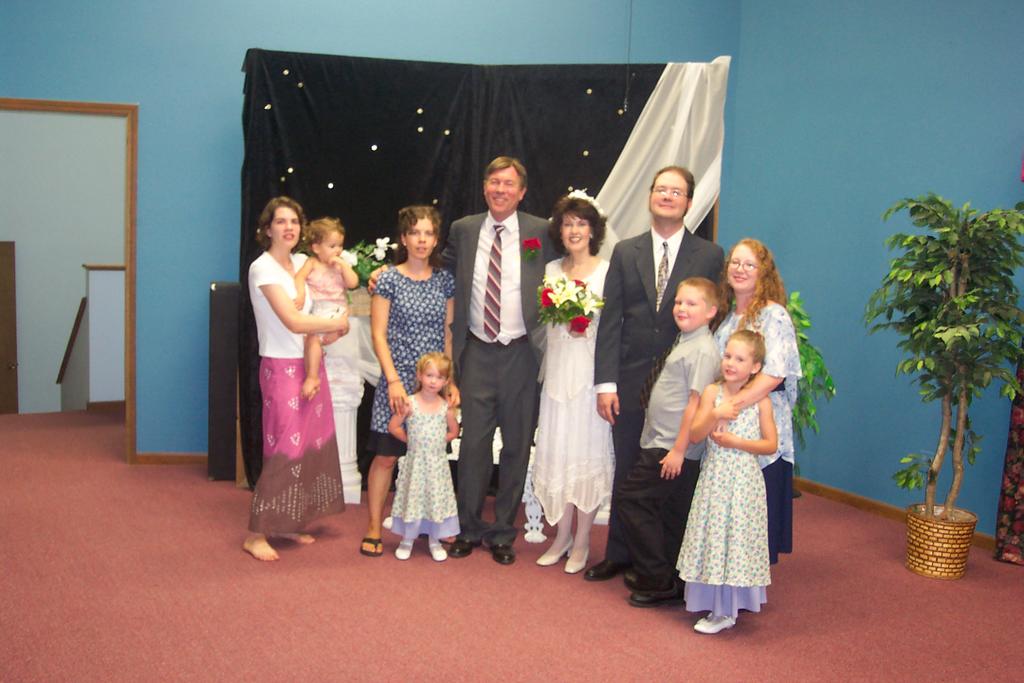
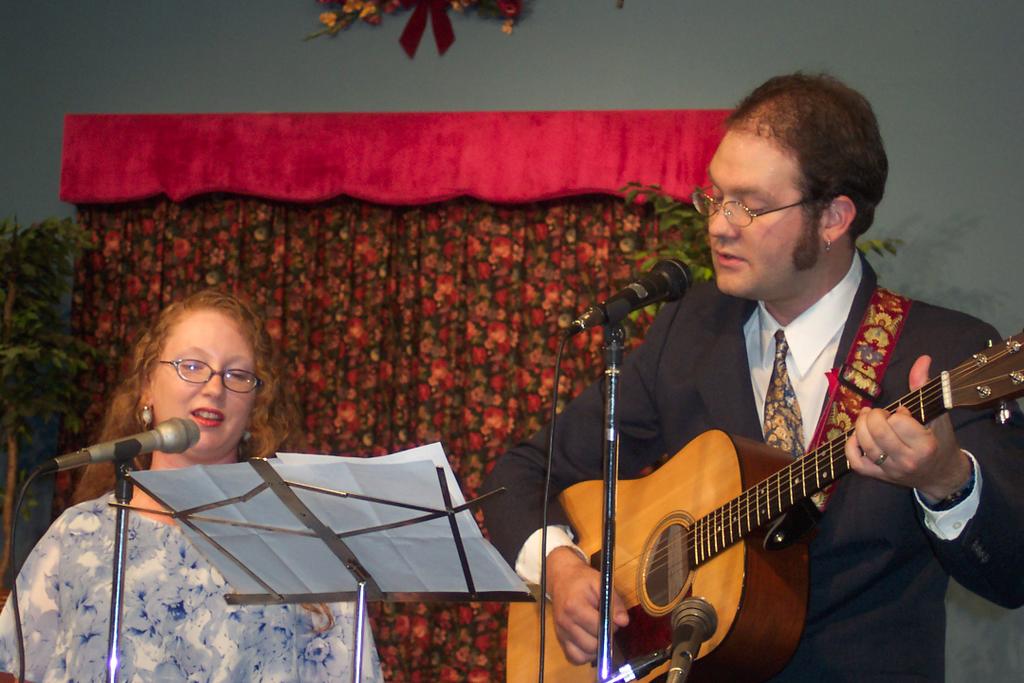
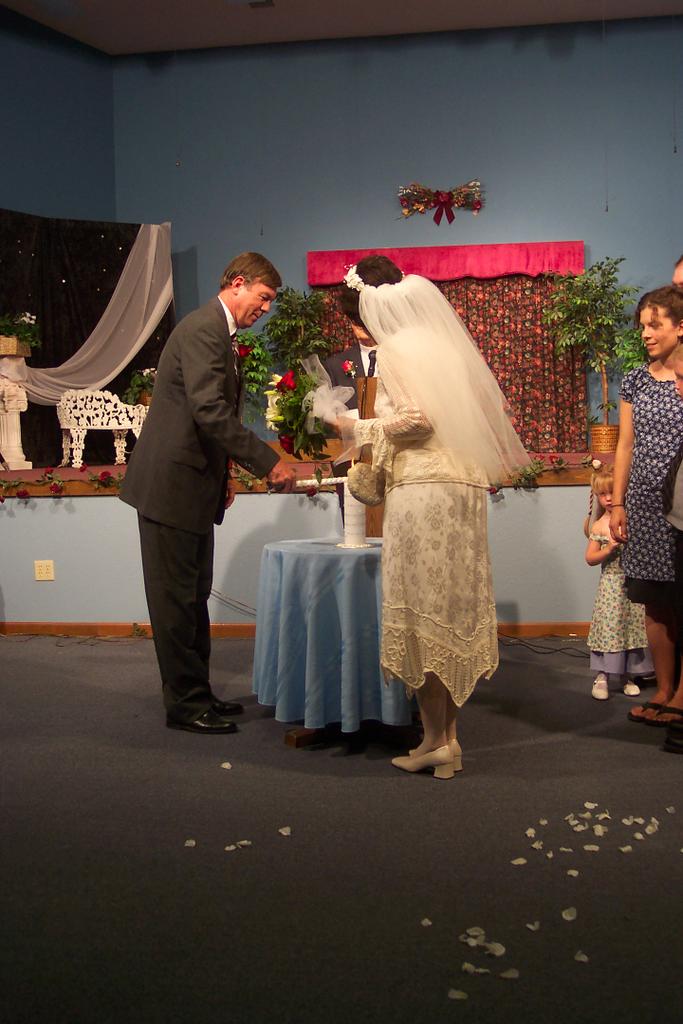
From last Wednesday until Monday, Martha and I took the kids and an
Amtrak train down to the Jeff City MO area for my parent's wedding vow
renewal. It was such a beautiful time. I'll have to post pics soon. But
the story I want to tell is on a little misunderstanding I perpetuated.
My sister found this little beautiful bed and breakfast for my folks as
a little second honeymoon retreat. The next day we all planned to meet
somewhere and have a picnic. Well Steph wasn't quite sure how the picnic
would all work out. We're all kind of on the poor side with not so much
cash flow. Anyway, we decide on this little winery nestled away
somewhere near Hermann. We all pull into this little place in a valley
and pile out. Four cars of us. Dad and my three kids situate themselves
under a tree and the rest of us go inside to watch people taste wine.
What else do you do at a winery? There was an all you can eat labor day
picnic going on there but we didn't know what it would cost and then
decided we couldn't afford it. The kids are filing in every few minutes
to use the bathroom. So after a few of us tasted the wine (not me) we
all filed out under the tree. I have my Martin out and I'm trying to
remember songs for us to sing. We chatted and munched on food dad saved
from the night before. Steak and cake and a bake potato wrapped in
aluminum foil. There were water bottles and Cokes. The owner came out
and saw us there and smiled. Somewhere in that time I started singing
"Whiskey River" by Willie Nelson. The owner must have heard me when
heading back in and saw us drinking from the water bottles. On my next
kid bathroom break he cornered me with "I don't know what you all are
drinking out there but we're not into that here. This is a family place.
We don't allow alcohol other than the wine we provide. What's in those
water bottles?" Boy was I embarassed. I forgot I'd been singing that
song until I got back to Chicago. I assured him we weren't drinking and
didn't drink. But shortly thereafter we all lit out of there feeling
like the freeloaders we undoubtedly were. It was a great hour and a
half. I'm blessed with a great family. Blessings on Jen and Nate as they
ready to wed. And on my folks on their new life together again.
9/08/2005
Been Readin. . .
On the train back from MO I had some time to read John Steele Gordan's History of American Economic Power (or something like that, sorry). Also been poking through Karl Barth's Preaching Through the Christian Year, his section on "Man and Woman"--the exegesis of one flesh. Also Bonhoeffer's new DBW Edition of Ethics . I've read the Intro and Afterword and earlier and then poked through "Heritage and Decay" last night. Much less troublesome for me than "Ethics as Formation." Also poking through Cardinal's manager Whitey Herzog's White Rat. How's that for a changeup?!! Go Sox and Cards. Please let it be in 2005. Not that I'm really even watching baseball much. I'm such a fairweather fan. Also reading Karl Barth's Theological Exegesis. I want to prepare a huge review bonanza on Barth for Cornerstonemag.com like I did for Bonhoeffer earlier this year. I could do it in December when he died or for the 120th anniversary of his birth in May '06. Either way I really need to know my stuff for this review and do it carefully and attentively as a layman with his cards clearly on the table.
The print deadline for the book we're publishing Season of Joy by Jim Benes is due Tuesday! Pray for me as I work my tail off this weekend. Hopefully a gang of us will be working. . . but we'll see.
On play is John Prine's song "Other Side of Town" from his album "Fair and Square." The thrill of his song "Some Humans Ain't Human" has long worn off now. It only serves to remind me to pray for humans I'm so quick to criticize and I'm startin to see those other five fingers pointing back at me. The song goes:
"Some humans ain't human/some people ain't kind/you open up their hearts /and here's what you find/a few frozen pizzas/some icecubes with hair/a broken popcicle/you don't wanna go there"
and then it goes on basically comiserating over the resentments us liberals no doubt feel all the time toward folks in power, our neighbors, and other folks in church. While I sympathize with the sentiment I pity the singer if he's unable to see his own judgemental attitude in the song.
The Twelve Steps teach that when I'm not at peace something's wrong with me. Socially and politically there's constant unrest with me and I'm sure all Americans with their eyes open. May I reach out for prayer for my government and myself during these fearful times. Its so easy to accuse, and sink into insanity and resentment. God help me to pray.
8/27/2005
I just got the latest issue of No Depression magazine. Its the ten year anniversary issue. It has Nickel Creek on the cover and interviews with Rodney Crowell, Son Volt, Marty Stuart, and of course Nickel Creek (never cared much for them, my wife luuuuuuuuuuuvs them though). Anyway, much is changing with this issue. They're officially dropping the moniker Alt. Country. They promise a new website soon with a blog. Oh and did I mention this issue includes a ten year retrospective on every previous mag they've done. And a top 25 list of albums over the last 10 years. If you don't subscribe get down to your local Borders/B&N/franchise--originality killing--chain bookstore and pick up a copy!! I'm sure I'll find plenty in this issue for use in my writing whenever the book deadline is past. (Lord haste the day!)
8/25/2005
Can we agree to disagree pt. II
I just gave examples that no doubt are easily named among political
rightists. But leftist examples are also clear:
turning a blind eye to sexual immorality, calling same sex marriage God
ordained, backing equally selfish leftist demagogues in their bid for
power, scripture twisting (just like the rightists) until it clearly
fits an agenda, demonizing and lying about the opposition, and finally
the idolatry of making God useful for their purposes.
God is of no use to either rightists or leftists. We all stand under his
judgement.
Now back to the agree to disagree, we should ask not for what we can
agree on but whether our only final option is separation. The truth is
the Evangelical landscape is so all encompassing that various works have
been in opposition to one another for years. The media spotlight now
aggravates it to be sure. I am personally amazed by groups like the
National Association of Evangelicals who have rightists at the helm and
many leftist and progressive thinkers helping to frame policy now who
are surely in large disagreement.
Can we agree to disagree?
Is it possible for Christians to agree on essentials, namely Christ's
person and work, and vehemently disagree on matters of social,
political, and public relations? That's a question that's been really
bugging me lately. Did Jesus come to bring peace and harmony and are
disagreements like these only getting in the way? I'm not so sure its so
cut and dry. The book of First John addresses both of these issues and
more. First he warns against those who deny Christ as the Son but he
equally warns that true Christians are known by their deeds. But for
those asking the question he admonishes to Love our brothers and
sisters. There is a lot packed into this little book! There is a time
to overlook one another's faults and bear with weaker members. But out
of love for Christ the work of exposing harmful directives (such as the
suggestion to assassinate leaders, to amass wealth even in shady deals,
to teach women they are naturally weaker and subservient to men, or that
one nation is God-ordained to commit crimes against another) for what
they are: sinful and against Christ's work.
8/24/2005
I just posted my comment on Pat Robertson's "Clarification" onto the comments on Blue Christian. It was too inflammatory for my own site here. I'd rather include such skullduggery where it belongs in Jon's corner. Anyway, to comment on my comment, I got heated because Pat appealed to Bonhoeffer. I've spent the last ten years gleaning from Bonhoeffer and to have Robertson misuse him is just plain hurtful.
Amira Haas article
I haven't blogged in a while about the Palestinian situation. Truthfully I feel shame for the distance time and circumstance have brought me from my solidarity with Christians in the Middle East. I still get all the email reports. I'm so bogged down with work and family that I have had no time for anything else. But my heart still beats in time--and breaks over my experiences in Israel/Palestine in 2002. I pray I'll get back there some day, and that the Christians in the West Bank and Gaza will have not all been forced out by the violence. A friend sent me this recent article from Amira Haas, a jewish reporter for Haaretz who has written extensively on life in Gaza.
http://www.haaretz.com/hasen/spages/616309.html
http://www.haaretz.com/hasen/spages/616309.html
8/19/2005
on a-bomb day i had nothing to say
I was struck dumb on the anniversaries of Hiroshima and Nagasaki. Look up Hiroshima on Wiikipedia and read all the pros and cons, that's what i did. I wanted to blog but my emotion struck me dumb. Brian Walsh gave a lecture at Cornerstone Festival in 2003 on Postmodernity and Empire. He said that being postmodern is never being able to get over the Bomb. That historical event overshadows every other action postmodern Americans take. I read this quote from the new 'Ethics," volume 6 in the Dietrich Bonhoeffer Works project: pg. 77, second paragraph:
I think it should be.
"That evil appears in the form of light, of beneficence, of faithfulness, of renewal, that it appears in the form of historical necessity, of social justices, is for the commonsense observer a clear confirmation of its profound evilness."I read that and I think of the use of the bomb on Nagasaki. Hiroshima was not enough. Somehow Japan wouldn't have surrendered with Hiroshima. We had to drop it again. And what of it all now? Is it even an issue anymore?
I think it should be.
Subscribe to:
Posts (Atom)