7/09/2005


Peanut Butter, aka Raggitt as we sometimes call her, is so much bigger now two months later. This is her on the day we brought her home. Martha says she's at least twice this size now. I think three times!

7/08/2005

With God On Our Side

"Barbaric" screamed the headline of the Chicago Sun Times this morning.
A mimic I suppose of the Governor's words of comfort after the subway
killings in London yesterday. Condi signed a condolence book. Blair and
Bush said our resolve is strong. We all feel better. Buddy Miller is
singing "With God On Our Side" on my Itunes. A few lines struck me a
different way just now. WWI: the singer doesn't know why we're fighting.
After WWII the Germans are forgiven, though six million Jews are dead,
but yes, they now have God on their side. Then its the Russians. The
question is where does it stop? Yesterday innocent die from "Barbaric"
acts and our leaders offer comfort by saying "This is what we're
fighting for." And as long as we're fighting we have God on our side.
This tangled weave of violence, assurance, war, and now more terrorism
beg the questions: Why Me, Why Us? Why Death? Who will protect us from
ourselves? Its easiest not to think about it at all. Personally I'm
irritated by our leaders. They offer assurances because that's their job
but do any of us really feel safer? I hate the spectacle of the news
after such acts. I hate the helpless passive gaze forced upon me. Christ
be between me and all this news. Christ be with all the victims and yes
with the perpetrators. Christ give me strength to feel. Christ give us
hands and feet to do something. Give me just one thing to do today to
counter that abhorrent act. And every recent abhorrent act between
humans that is far less than human be it in conscious warring or
otherwise. One simple thing please.

my fest experience

Its the last day of the week in which I retreated to Chicago from a week and a half of tent living in Bushnell Illinois. I suppose I am that much richer, more patient, and more eager for Parousia because of the experience. I'm glad I will not be loading and unloading trucks and minivans for another year. Trucks bearing all the wares of my trade and that of everyone else who works in this building. All the writers and artists I see year round in passing on their ways to the delapidated bathrooms here on second floor. Some emerge from their windowless offices from hours of staring into their 15" monitors just to stand where there are windows and remember that they still speak with human voices and see daylight. [If they ever read this we'll have more to talk about. Or maybe they won't want to talk anymore at all for fear you'll hear about it!]

Its a wonder that I and these pretend to be outside dwellers for over a week once a year. Its a wonder that we inhale the dust of Illinois cornfields and burn our skin with the sun and then freeze ourselves upon nightfall inside temporary dwellings of vinyl and barely metal zippers. Maybe we do it because it makes us feel like anything is possible with a truckload of ice and water and per diem enough to make us smile. Some of us spend the entire year in preparation for that one week (or four days for others). This year I fell into the week with 1000 and 1 other things pressing.

On the other hand, the Fest is about conversations otherwise not had with folks from all over the world. This year I'll mark in my memory one lengthy conversation with a young man about Existence, Evil, Spiritual Encounter, and the Effect faith has on a person. His questions and my poke at answers changed me. Bolstered my faith. The reality of an all powerful God who loves me and desires a relationship with me never ceases to be a tender and moving subject. The fact that I grew up a believer and that faith has always been my life theme has not kept me from utter failure, addiction, and betrayal of all I love. That part of my narrative makes my testimony a tricky delivery, but a bittersweet joy nonetheless.

I mark this fest as a victory in the resistance of temptation. I kept the personal conversation going, did not withdraw and isolate from my fellows, and I am stronger for it. Lust, despair, anger, and discouragement plagued me as usual but I can honestly say I reached out to God and my brothers and with their help stayed faithful. Yeh, desperately faithful.

We brought our house rabbit down with us. She (Peanut Butter) managed to stay cool and get exercise and be lots of fun. Martha and I took the kids to the beach at the man-made lake down the hill. I got in at least twice and splashed around. Back at the campsite for at least two days I got some quality reading in. I read "I Knew Dietrich Bonhoeffer" which I got on inter-library loan, and "Karl Barth's Theological Exegesis" by Richard E. Burnett which I still hope to review later this year. Later I purchased from my own store "3 by Flannery O'Connor" and began "The Violent Bear It Away." Somebody tell me if that's OK to read first. Though I don't really care. The byline about devoted prophets killing folks out of love for God was enough to make me pick it up. Though that must happen at the end. Anyway. . . .

Martha is amazing in her tenacity and patience for camping. Everything was carefully packed in bins and she managed to remember everything our family of five needed and pull off providing tents for the rest of JPUSA as well. We couldn't have managed without my good friend Michael. He was a real trooper in the back seat with the kids on the way home. My three year old was so much trouble! I often asked how could something so cute and tiny be such a royal pain!?! Darling--rascal--darling--rascal. I was stopping the van so much to deal with her on the way home that it felt as if we'd never arrive.

Well there it is. And I've relived it all just for you. Feel special.

6/24/2005

a little theological reflection

All right, I'm gonna stick my neck out here and offer a little of what I've been reading again this morning. By way of explanation the thoughts in the following paragraph were part of a spiritual search I was on a number of years ago. As a teen I began reading Dietrich Bonhoeffer and Karl Barth's name kept popping up. When my wife and I moved to Chicago I had more study time on my hands and I began mining our huge library downtown of its Bonhoeffer collection. One day I stumbled on this book After Fundamentalism by Bernard Ramm and it was like finding a key to the prison of so many of my doubts about what I believed, the chief issue being Apologetics. My spiritual awakening took place in the late 1980s and at the time Apologetics and Evangelism were joined at the hip. I may be wrong but I suspect that the vast majority of Evangelicals are still so situated. But when I read Hume, Voltaire and Neitzche, and took their positions seriously, I realized that Apologetics so situated with Evangelism just doesn't work. Its an obfuscation of the Enlightenment. Ramm calls it obscurantism. Now this is not to try to shatter Thomas Aquinas or the classic arguments for God's existence. Its simply to say that to think that reason forms the basis for Evangelism is to not see the big picture. America has nearly 230 years of experience with Evangelicalism. To say that Christianity is the only reasonable choice is to claim that all rational arguments in opposition are denying the obvious. To me that is not a conversation starter. Well my lead-in is now longer than the quote:

"One of Barth's basic presuppositions with reference to the truth of the Christian faith is that if something external to the Word of God is necessary to establish the Word of God as true, then it is greater than the Word of God. He states this in many ways and in many contexts. Or, one could say that it is a very weak Word of God that needs external supports. Barth's maxim is that what establishes is greater than what is established. But there can be nothing greater than the Word of God. Therefore the Word of God establishes itself. If the lion needs gophers and rabbits to announce his kingship, then the lion is no longer king of the beasts. Barth takes as axiomatic that it would be very strange if Christian could believe the faith only if there were external assurances for it. If Christianity is tested for truth, then the test is greater than Christianity."
[from Bernard Ramm, After Fundamentalism: The Future of Evangelicalism, Harper & Row, 1983., pg. 61.]

To me Lee Strobel is the case in point here. His maxim (with his books The Case for Christ, The Case for a Creator, and his TV show on Pax ) all claim to want to dialogue with Mainstream America. Instead what he does is misrepresent all opposing views, tell the reader or viewer what he believes they want to hear (his opinion) and then draw a straight line from his point of view to Jesus. His testimony is that of having been a liberal radical atheist who wanted to attack Christ to becoming a far right wing conservative because of the facts. I surmise there's more to his story. This is the essence of Apologetics and Evangelism gone wrong. To me what is really being said is: "If Christianity can't be made to suit an agenda (mine) then it can't be true." I say that any real survey of worldwide Christianity shows that Jesus is much too colorful and influential for different reasons than to be fit into any one person's box.

Ok, with all of that said, there are many good and honest folks involved in Apologetics and Evangelism. And Karl Barth's deemphasis of Apologetics was quite honestly his own form of bias due to his background.  Political conservatives coopting the Apologetic conversation form no final reason to completely disregard a place for Apologetics. CS Lewis is a great example of a Lay apologist as is Josef Pieper. Various contemporary Christian philosophers all do a good job. But I think even these would shy away from claiming an epistemology (how we come to faith) that is all encompassing.

6/22/2005

Choosing Not to Cuss

On Choosing not to Cuss:

Does it really offend you Holy Spirit when four letter words fall off my
lips? Why? Is it because you're so easily offended and moralistic? Is it
because you're too good for me? Does the music I listen to offend you
because it is not Praise? Is your favorite station WMBI? Are you
offended by all the rest? Holy Spirit are you too holy for all of us
here in Chicago? Is Benny Hinn really your kind of man? Why are you not
offended by his greeting every morning? ("Good Morning, Holy Spirit" was
an old book by him.)

These questions reveal a bit of bitterness in me, its true. Why this
rash of interrogation? Because I've been wrestling lately with the
question of profanity. I don't cuss because it doesn't suit me. But
profanity reveals a deep anger and bitterness in me that is very close
to my heart. That's scary to be sure. But how else can the fear and the
rage be pronounced? Its how my neighbors express themselves and I find
it tempting. Less sinful than smoking or drinking or whoring to be sure.
Its only tempting deep inside me.

Holy Spirit I know you're not too dainty for my world. Not too quaint,
not too small. I offend you because you love me. My faith I fear is
quaint, dainty, small, maybe even handicapped. You are strong and bold.
You cut through all the crap to the real me. You are no doubt offended
not by the language but by the force inherent in the ribold rejection of
your Ways. The language reveals the bitterness. And so, as I do every
day. I surrender my emotions Father God, Jesus Lover of my soul, Sweet
Holy Spirit. I am broken. You are the cure. Have your way with me. I
choose not to cuss. I surrender. Because you are strong. I am the weak
one. Cussing is a false armor for my conceit. A false armor for the fear
and rage. It makes me sound big, creates a front which does not suit me.
Christ be between me and all others this day. Between me and the words I
speak. Christ you are the only Significance.

gonna tell stories

I'm burning a disc of my favorites from "Down to the Promised Land," an
old compilation of artists on Blood Shot Records here in Chicago.

Just to demonstrate how weird I am, I'm also peering at "Myth and
Christianity" a paperback copy dated 1958, by Karl Jaspers and Rudolf
Bultmann. I collect these kind of books and surround my writing space
with them.

Now I forgot what I was gonna say. Somebody just called me and I can't
return to what I was gonna right about. I hate it when that happens.
Thanks a lot Michael. Uhhhhhhhhhhhhhhhhhh.

Oh yeah:

I'm in a place of limbo in my life right now. But I've always been in
limbo and that's what I want to write about. I'm 31 at this writing. I'm
ten years married with three little kids. I've got work that really
interests me and friends (and a lover in my wife) like I've never had in
my life. That's a lot to be thankful for and as good a place to
recollect as any. Edward Siad wrote a book called "Out of Place" during
a time in his life when he thought he'd be dying soon. The book is
wonderfully mundane to me in many ways. As a professor of English and
Comparative Lit at Columbia University and as perhaps this generation's
most well know and vocal American Palestinian or Palestinian Expatriate
you'd think his memoir would surround his political coming of age. But
in a beautiful way he just told the truth about his boring childhood.
Well I'm not near as interesting as Edward Said to so many people. But
someday I'm gonna lasso my story (lasso?, yes country music does that!)
and tell it.

It'll be full of crazy stories about a guy a knew trying to kill a roach
that crawled into his ear with a Qtip.

Another about a guy taking a big swig of piss that had mysteriously
found its way into the refrigerator. Now that's a story. I can imagine
my six year old girl's reaction to that one. I'd never live that down.

Calling my dad out off of a construction site to tell him if he's gonna
vent on my wife-to-be he's gotta go through me. Then telling him he is
downright evil.

Picking up a sledge hammer and smashing a watermelon off of my friend's
head because I think he's acting too stupid. Getting angry at him the
same way my dad did at me that month previous.

The shock of learning the following week that that friend died in a car
accident. The shame of never being able to say sorry.

Lots of stories. Too little time to tell them now.

6/13/2005

Been readin' lately

Well Alright I've been book tagged by Blue Christian Jon and now with an obnoxious glare I'm going to admit to what I've been reading lately. Now I read for different reasons. Some books like The Man Called Cash by Steve Turner I read for sheer pleasure. Then I walk around boring everybody with my knowledge of the odd doings of a personal hero and legend but nevertheless old and now dead guy, Johnny Cash. If I were my son I'd think I was strange, but that's another story.

I recently prided myself in finishing On Love from Faith, Hope, Love by Josef Pieper. It makes up more than half the book. Faith and Hope take up like 40 pages each but Love must be closer to 140 pages. I counted the other night but now I can't remember. Anyway, there's reading and then there's READING and Pieper makes you feel every page. If you don't know Josef Pieper I'll just say he's a classically trained Thomist whom I really enjoy. I began with his book Abuse of Language, Abuse of Power which a Catholic friend gave me years ago. Well it was so timely and well put that I asked Jon about Pieper's book on Eros that he'd mentioned was so good. [The first self-proclaimed Thomist I encountered scared me to death. I was studying in the St. Louis public library on Locust and this Aquinas student just kept bringing photocopies of books and laying them beside me telling me to read. And I kept going from floor to floor trying to hide until he'd find me and say "check this out" until I finally said "I'm not interested please stop!" But I digress. ] Pieper's fresh introduction to Aquinas and Classical thought makes me want more and more. Though I'm full for a while with On Love thank you very much. I ordered Pieper's The Four Cardinal Virtues to sell at the Fest on the advice of a trusted friend here. I've got to buy a copy of Faith Hope and Love soon so I can mark up my copy of On Love and use it in some memoirs someday. There's a lot of clarification of what Love is and isn't that I've never seen hashed out anywhere else. I did read Lewis' The Four Loves and Pieper quotes him a lot. But Pieper quotes all the important writers, philosophers, theologians, and pundits of love from the 20th century and then sits back and profoundly lets it all make sense, or sometimes make questions. Either way I really had fun. There should be a quote somewhere about how some folks like me can't really understand things unless they're explained in little forty page philosopho-speaks by guys with German names. Then after sheepishly agreeing with whoever gave the quote I'd swear never to be like that in real life.

I've been skipping around through The Secular City by Harvey Cox. The chapter on sex was very good for the most part. Boy that sounds weird. Just picked up The Technological Society by Jacques Ellul two days ago and I'm heading into chapter two. Its one of those books I just start nibbling into thinking "there's no way I'm really gonna finish this." And then I just keep reading and reading cuz its good.

The book that has become my life lately is titled (today):
From Tannenbaums to Handel's Messiah: A Chicago Christmas by Jim Benes (to be released in the fall of 2005). If you've seen Chicago Christmas, this is the revised and expanded version. I told Jim a few months back while peering over the stacks of papers and photos that filled the 4x10' table "Man, I feel like I'm entrusted with your life's work." To which he replied "Oh please, its just a hobby gone awry." I laughed. Then I hung up and cried over the work to be done.

books I'm not reading: The Purpose Driven Life by Rick Warren, The Case for a Creator by Lee Strobel, The Left Behind Series by Lahaye and Jenkins, Your Best Life Now by Joel Osteen.

That's what you get for book-tagging me.

Here's the List of Books I'm bringing down to Cornerstone Festival this year. In addition to money for CDs and Tshirts please bring money for lots of good books! By buying these books and used books you'll be supporting the good work of this good-little-nonprofit-that-could. Shameless merchandising. Shameless. I'm shameless. Cuz I still wouldn't mind working here next year. One foot in front of the other.

Asterisks are next to books you get 15% off for if you say you are attending that seminar.

Speaker Books, Course Related Material, Generally Good Reading

A Long Obedience in the Same Direction - Petersen, Eugene
Blue Like Jazz: Nonreligious Thoughts on - Miller, Donald
*Bravehearts: Unlocking the Courage to Lo - Hersh, Sharon A.
Breaking Free: Understanding Sexual Addiction and the healing power of Jesus - Willingham, Russell
*Death Comes for the Archbishop - Cather, Willa
*Denial of Death - Becker, Ernest
Dietrich Bonhoeffer: A Spoke in the Wheel - Wind, Renate
Field Guide to Narnia - Duriez, Colin
Four Cardinal Virtues - Pieper, Josef
Four Loves - Lewis, C. S.
*Generous Orthodoxy: Why I Am a Missional etc. - McLaren, Brian D.
God's Politics: Why the Right Gets It - Wallis, Jim
Gospel According to America: A Meditatio - Dark, David
Into the Region of Awe - Downing, David C.
*Last Word and the Word After That: A Tal - McLaren, Brian D.
Life You Save May Be Your Own: An Americ - Elie, Paul
Long Loneliness - Day, Dorothy
Mere Christianity (HarperCollins) - Lewis, C. S.
*Mom, I Hate My Life!: Becoming Your Daug - Hersh, Sharon A.
Mystery and Manners: Occasional Prose - O'Connor, Flannery
*New Kind of Christian: A Tale of Two Fri - McLaren, Brian D.
*Pensees (Revised) - Pascal, Blaise
*Propaganda - Ellul, Jacques
Real Sex: The Naked Truth about Chastity - Winner, Lauren F.
*Return of the Prodigal Son: A Story of H - Nouwen, Henri J. M.
Scandal of the Evangelical Conscience: W - Sider, Ronald J.
Screwtape Letters - Lewis, C. S.
Searching for God Knows What - Miller, Donald
*Story We Find Ourselves in: Further Adve - McLaren, Brian D.
Subversive Orthodoxy: Outlaws, Revolutio - Inchausti, Robert
Under the Overpass: A Journey of Faith o - Yankoski, Mike
*Anarchy and Christianity - Ellul, Jacques
Christian Wisdom of the Jedi Masters - Staub, Dick
Girl Meets God: On the Path to a Spiritu - Winner, Lauren F.
I Loved a Girl: A Private Correspondence - Trobisch, Walter
Living Like Jesus: Eleven Essentials for - Sider, Ronald J.
*Singleness of Heart: Restoring the Divid - Williams, Clifford
Subversion of Christianity - Ellul, Jacques
The Lion, the Witch, and the Wardrobe- CS Lewis
Three by Flannery O'Connor: Wise Blood/T - O'Connor, Flannery
Tolkien Reader - Tolkien, J. R. R.
*Works of Love - Kierkegaard, Soren
*Life of the Mind: A Christian Perspectiv - Williams, Clifford
*Purity of Heart: Is to Will One Thing - Kierkegaard, Soren
Signposts in a Strange Land: Essays - Percy, Walker

Cornerstone Press Titles

Growing With My Garden: Thoughts on Tending the Soil and the Soul - Rolland Hein
Hammers & Nails: The Life and Music of Mark Heard - Matthew Dickerson
C.S. Lewis: Mere Christian - Kathryn Lindskoog
The Harmony Within: The Spiritual Vision of George MacDonald - Rolland Hein
Christian Mythmakers, 2nd Edition- Rolland Hein
Flannery O'Connor: A Proper Scaring - Jill Peláez Baumgaertner
Finding The Landlord: A Guidebook to C.S. Lewis's Pilgrim's Regress - Kathryn Lindskoog
Wind of the Journey: Poems - Irina Ratushinskaya
*The Responsibility of the Christian Musician - Glenn Kaiser
More Like the Master: A Christian Musician's Reader - Kaiser, Card, Peacock, et al
Selah: A Guide to Music in the Bible - Donald Thiessen
The Double Vision of Star Trek: Half-Humans, Evil Twins, and Science Fiction - Mike Hertenstein
Selling Satan: The Evangelical Media and the Mike Warnke Scandal - Mike Hertenstein and Jon Trott
Orphan Girl: The Memoir of a Chicago Bag Lady - Marie James, as told to Jane Hertenstein
Home is Where We Live: Life at a Shelter Through a Young Girl's Eyes
Organic Faith: A Call to Authentic Christianity - Ron Mitchell
Dinosaur Journal: Making Sense of a Young Son's Death - Curtiss Mortimer
My Son, My Brother, My Friend: A Novel Letters - Dale C. Willard
Beyond Belief: Cartoon Confessions of Faith - Roger Judd

6/01/2005

The Sacrosanct Mind

Jon Trott needs to link to my blog  from his blog right now!!! bluechristian.blogspot.com


It occured to me this morning lying in bed that of the things I value most in life, my mind is the greatest. Now if you asked me whether I considered myself a truly smart person, an intellectual or an artist, I would be embarrassed to reply "Yes." But I do spend most of my valuable time in mental exercise. I love reading five or six books at a time. With this activity comes the very real threat of information overload and very little control over what goes through my mind. An athlete these days spends a considerable amount of time suiting up and/or toning up so as to protect him/herself from injury. In the mental realm as a believer in Christ I have the Word of God to protect my mind. Now all of this sounds very basic, even fundamentalist. This idea was drilled into me from childhood. But this morning when the thought of "Take every thought captive to the obedience of Christ" came to me, I realized that somehow I value any thought for my ability to think it, for my freedom to think it, and don't see a need to take  it captive. Captive sounds like such a militant dominating kind of thing. Thoughts are just thoughts right? I mean thoughts are harmless, they come and go. Why would I need to take them captive?

Here are the verses in question:

2 Cor. 10:2  (NASB)
2  I ask that when I am present I may not be bold with the confidence with which I propose to be courageous against some, who regard us as if we walked according to the flesh.

3  For though we walk in the flesh, we do not war according to the flesh,
4  for the weapons of our warfare are not of the flesh, but divinely powerful for the destruction of fortresses.
5  We are destroying speculations and every lofty thing raised up against the knowledge of God, and we are taking every thought captive to the obedience of Christ,
6  and we are ready to punish all disobedience, whenever your obedience is complete.

The Dictionary of New Testament Theology Vol. 3 (p. 591) says Paul uses the word  for captive, aichmalotizo, in reference to the ongoing battle that is the Christian experience.

Reflecting on his Christian expereince, Paul writes: "For I delight in the law of God, in my inmost self, but I see in my members another law at war with the law of my mind and making me captive to the law of sin which dwells in my members" (Rom. 7:22f.;--doulos;--I Am, art. ego eimi, NT2 (c)). On the other hand, his concept of the new life as an exclusive union with the Lord allows him to use aichmalotizo of the service of Christ: "We lead every thought into captivity to make them subject to Christ" (2 Cor. 10:5; cf. 2:11; 3:14; 4:4).

In this way taking thoughts captive to Christ is pitted against having thoughts captive to sin. (Dylan) You Gotta Serve Somebody. Now the humbling reality is that either way, I am not the one in Authority. I remember reading Ralph Waldo Emerson in college and being stunned by the sheer audacity of his Self Reliance:

Nothing is at last sacred but the integrity of your own mind. Absolve you to yourself, and you shall have the suffrage of the world. I remember an answer which when quite young I was prompted to make to a valued adviser who was wont to importune me with the dear old doctrines of the church. On my saying, "What have I to do with the sacredness of traditions, if I live wholly from within?" my friend suggested,---"But these impulses may be from below, not from above." I replied, "They do not seem to me to be such; but if I am the Devil's child, I will live then from the Devil." No law can be sacred to me but that of my nature. Good and bad are but names very readily transferable to that or this; the only right is what is after my constitution; the only wrong what is against it. A man is to carry himself in the presence of all opposition as if every thing were titular and ephemeral but he.  [Concise Anthology of American Literature, Third Edition, pg. 591.]

Now all of this smacks to me of the same pretensious blow-hardedness (if that's a word) that I encountered the other day from a loud fan behind me at the White Sox game. It was the bottom of the ninth and the Sox were down a few runs. The manager kept in the starting pitcher. This fan went nuts! It was like his pants were on fire. All the insults he and his friend had shouted at the opposing pitcher were now aimed at the Sox manager. A few fans got up to leave and he started insulting them! "What kind of Sox fans are you!" In this fans mind the whole world around him was his to command because of the Season tickets he purchased before the season. Maybe he lives that way. (No wonder he was unmarried!)
At any rate, whether its Emerson's assumed license to command because of learning (or  in existence), or this fan's right to command because of his loud voice and tradition of being a fan, neither men have any real control, either of themselves or the world around them. And they witness to me of my own pretentious love affair with my mind. I've heard it called mental masturbation. Not a pretty picture.

A Closing Prayer

Dear God for today (because that's all I have) I surrender control of my will to yours. "I offer myself to you--to build with me and to do with me as You will. Relieve me of the bondage of self, that I may better do Your will. Take away my difficulties, that victory over them may bear witness to those I would help of Your Power, Your Love, and Your Way of life. May I do Your will always!"(The Third Step Prayer, Alcoholics Anonymous, pg. 63)

5/31/2005

Memoir and Remembering

When I began my study on Memoir I found a philosophy book on
autobiography and remembrance. It raised the question of authority in
remembrance, and its my largest hurdle in writing memoir. Its a question
of personhood really. Who am I to remember aloud--to recount deeds done
to me that shaped me? The question becomes particularly hurtful when it
involves parents, spouse, siblings. . . . or my own hurtful dealings
with others. Perhaps this is why so many personal experiences must be
fictionalized. True remembrance is always only through the lens of
perception. Perception is open to doubt. Doubt brings fear and pushes
the attempt at memory to arms length. Not that doubt and fear can't
dissipate. But anything written becomes posterity---when read.

5/22/2005

Well I went and saw Star Wars: Episode III with my dad the other day. Its hard to explain the experience. I grew up with Star Wars. My first favorite toys were Star Wars figurines, especially Luke Skywalker. Seeing Episode III was like the missing piece of the whole puzzle. The piece that makes the whole thing fit, you know. So its like a crack in the universe where everything's finally been revealed. My dad has only watched the movies passively. He remembers bits and pieces here and there but he didn't understand a lot of what was going on. I kept analyzing the scenes theologio/philosophically and then noticed that it was keeping me from the story itself. But each scene in this last film has all this abiding saga significance. I really got into Bin Kenobi's statement to Anakin on the volcano, "Only Siths deal in Absolutes." At first I thought, well the Right's gonna pick up on that and say, "See they're preaching Relativism." But then when I thought deeper the truth of the statement made me rejoice. Its not a question of Absolutes, its the Dealing in Absolutes. Perhaps that's where the Right to me are like Siths. The Sith Lord promises Anakin the power to save loved ones from dying. Benny Hinn, Kenneth Copeland, Joel Osteen all make this faith promise that with their kind of faith healing, wealth, and day to day power are all a guaranteed reality. Our president promises that with the philosophy and guidance of his neo-cons' New American Century he will rid the world of evil and accomplish the impossible: Democracy and Peace in the Middle East. The Christian Right believe they finally have a truly Christian president, moreso than any other president in history. That is dealing in Absolutes my friend. Ok, now I'll admit I'm constructing a narrative out of sci-fi for present reality and it doesn't really fit. But I've got that right as much as anyone right?

I just saved a bunch of religious film criticism articles on the Star Wars series here are the links:
http://www.unomaha.edu/jrf/CREDITS/Star_Wars.htm
http://www.unomaha.edu/jrf/disctopc1.htm
http://christianity.about.com/od/themovies/a/starwars_p.htm
http://christianity.about.com/od/themovies/a/starwars_2.htm
http://www.leaderu.com/focus/starwarsspirituality.html

I'm sure there will be many more discussions and essays by the end of the summer. I expect that this movie will lock up the box office this year as it should. I was more moved by this one than any of the others. It packs more theologio/philosphical reflective scenes into it than any of the others that I can remember. My dad's remark was that he never saw one tree in this whole movie. Ecology itself was sucked out of the narrative as death came to the front. He was amazed at the cities without anything but buildings in them. I pointed out that they were noticeably absent for a reason and that other worlds such as Naboo, the Ewok moon, and the world of the Chewbaccas were all in harmony with nature rather than without a need for it. They were primitive civilizations who were by-in-large rebels of the powers that be. But their people are the story's heros, working to restore what is good and right in the galaxy.

Star Wars is a morality play to be sure, with Anakin Skywalker as the central character. The son, Luke, has his own struggle for identity, but his father's life is very much a part of his own struggle. When he learns this, the Force and his father become central to his own search. That struggle resonates with every man I'm sure to some degree. Though truthfully the sons who can confront and be confronted by their fathers are rarer indeed.

5/05/2005

gone

gone

yeh i like it better now that you're gone
its better being alone
i can enjoy my music alone
i don't gotta worry what you think
i don't gotta talk to you
i don't gotta look at you
and i'm happier
knowing you're happier
not thinking of me
living your own life
your so free


5/03/2005

this morning

It was after I had had my quiet times this morning. My second cup of coffee was down to a quarter of a cup, which usually stays out on the counter for the rest of the day. I'd read the morning devotional, followed the daily morning readings for the day from the book of common prayer, and was feeling pretty good really. I'd moved on to a book I'm reading slowly, Wilco: Learning How To Die. Chapter Four entitled "No Depression" on the band Uncle Tupelo, which if you read me you know is one of my favorite bands. My son (who is nine) comes in and Martha and I start talking about vacation. We're on a limited budget this year. $1000 and probably 1000 miles. No doubt $200 in gas one way. We'll do our traditional shoe-string trip that involves freeloading with family and staying ten days in a borrowed domain. This year brings us to Eureka Springs Arkansas. Halfway through the conversation my son starts going on as he does about not getting what he really wants on vacation.

He wants a Gameboy Advance and we say we'll put it on the list. We explain we can't guarantee it but we do want to get it for him. Soon the thought that he may not get it gets too overwhelming and he begins tearing up and then really bawling. And there I sit reading my book. I'm beginning to get overwhelmed with irritation and I just choose to ignore my feelings in that situation. And then it occurs to me, am I a distant dad just like my dad was when I was that age? I look back and realize I got into books, nonfiction, theology, sociology, philosophy, in a desperate attempt to get close to my dad. It worked sometimes. But mostly he was gone or when around I did his chores or just stayed out of his way. The door was locked all week so he could prepare his sermons. I remember knocking for nothing in particular and it really pissing him off. He'd say "What do you want?" And I'd say "Nevermind" and leave and then he'd grab me and say "No now you're going to talk to me." And then whatever I had to say seemed terribly insignificant to me.

Truth be told I could hardly care less about Pokemon and Gameboy advance. He's into it because all his friends are into it. Otherwise he wouldn't care really. He's got a PS2 that we play together. Pokemon to my knowledge makes no products for PS2. That adds to the irritation. Anyway, will my son look back and remember that I didn't care about Pokemon? That I showed no love that day and buried my nose in my book and punted to Martha? Well yeh that bothers me. Somehow I've got to hurdle my stupid little irritations and connect with him. After vacation I'll have finished the Wilco book and I'll have grown closer to this old drunken band that broke up and will be no closer to my son. God help me connect with my boy! And God return my lost youth to me and soften my crusty old heart. I wasn't allowed to have a childhood of significance. Games, toys, and baseball cards were of no significance to the Kingdom of God. But I think toys and recreation are important to God now because they're important to kids for development.

Why was I irritated by this little boy sitting next to me with tears streaming down his face? The thought of not getting that game really rocked his world. I want to give him this toy but more importantly I want him to know that he's important to me. We'll find ways of connecting in the next few weeks. I tell him all the time that he's my favorite little boy in the world.


4/22/2005

The Downfall

I went out with a group of friends and saw "The Downfall" last night. It
was intense and troubling. At first I couldn't think of anything in the
American experience to compare with the German fixation for National
Socialism. We demonize Hitler and place him on an evil pedestal to the
effect that "well that'll never happen again." Read Jonathan Glover's
"Humanity: A Moral History of the Twentieth Century." The facts of later
history reveal that we've let it happen again and again and again. And
its not slated to stop any time soon. Hitler's ideology brought down an
entire nation. Dietrich Bonhoeffer chose to die trying to stop Hitler as
an expression of his faith and be numbered with the Jews at
Flossenburg. "The Downfall" was a German director's attempt to reflect
on his people's history. As an American viewer I'm trying to process our
parallel history as the "righteous victors who would never do anything
like that." Let's look again: genocide of hundreds of Native Americans
from Columbus on, an economy that flourished because of the slave trade,
coming out on top after two world wars in the world economy, "righteous
enough" to drop two A-bombs "for peace", and on and on. "Let's not call
the events in Rwanda genocide" (Madeleine Albright, Bill Clinton, Kofi
Annan) How is American Democracy and Globalization not its own ideology
that paves a superhighway over the poor masses in the name of consumer
progress? And where is Jesus now in all this Democracy? What right have
we to pray for the countries we conquer?

Bonhoeffer reviews/article up

cornerstonemag.com

4/17/2005

I've been working for the last two weeks on this article on how JPUSAs use the writings of Dietrich Bonhoeffer and identify with the aims of his community. My biggest hurdle is to make all these academic texts accessible to lay folk. Taking lofty propositional truths and clarifying them is a dance to say the least. The big test will be when I'm ready to share it with others. Martha has read it and found it too lofty for her. I'm getting to the most academic part, on the need for Bonhoeffer's Bruderhaus and the need for JPUSA. Its far easier to comment on the need and impact of an extinct community. JPUSA is well known and controversial enough to make any comparisons I draw a strain. Craig Slane comments on the need for rituals in Bonhoeffer's community to counteract the Nazi nature propaganda and rituals. I wish I could draw a straight line between the American consumer cult and JPUSAs daily activities. There's no way to call them ritual though. And how our activities effect behavior is hard to tell as well.

4/06/2005

This time let me start with my beautiful wife. And not just because she's in the room. I'm so thankful for her help in big and small ways. She is really so lovely. I don't know that I can really appreciate true beauty yet and I fault myself for that. At 31 I should know what true beauty is but I fear it miss it often. But I know she is true beauty and I look forward to getting to know her beauty more with each new day as God gives me the grace and as I get to know her better as we get older. I'm still learning to believe in a Higher Power who can rescue me from myself. And as I get to know him better I trust he will reveal her beauty to me in deeper ways. Thank you Jesus.

3/22/2005

I just read my blog to my wife and somehow I left her out. Really I can't go more than a few hours without needing to hear her voice or show some affection. How could I have left her out?
Lately I've been working on reviewing half a dozen Bonhoeffer books for cornerstonemag.com due to be posted on or before the sixtieth anniversary of his death April 9th. And there's this new book out Toward An Evangelical Public Policy by Ronald Sider and Diane Knippers which has sixteen chapters that I'm trying to absorb for review/interview. Then there's an ad due that I have to design and some accounting due. Then there's three cute little kids needing attention and a PS2 MX game I bought "for my son." Sound like enough to keep me from blogging?

3/07/2005

From Wikipedia:

Conservatism vs. fascism

While conservatives often identify with nationalist movements, there is a clear distinction between conservative nationalism and the ultra-nationalism of fascism. Conservatism, at its root, is an attitude of political and social quietism. The big plans of the Big Man, the noisy and levelling mass movements, the FĂĽhrerprinzip, the personality cults, and the strong propensity toward totalitarianism that are central to fascism, are antithetical to the positions of classical conservatism. Conservatism stands for learning from the mistakes of the past, and primum non nocere is an essential conservative principle.

Nonetheless, historically, some conservative traditionalists have been drawn to Fascist movements, just like some liberal have been drawn to Communism and Stalinism during the 1970s. Some may have admired the moral and military renewal that Fascist leaders promised. Others may have merely thought fascism a more palatable alternative to socialism or communism. For example, in mid-1930s Britain, conservative media baron Lord Rothermere's Daily Mail enthusiastically backed Sir Oswald Mosley's British Union of Fascists, whilst a number of Tory peers and MPs supported closer ties with Nazi Germany. For a more contemporary example, in a 2003 article in National Review, John Laughland accuses contemporary neoconservative Michael Ledeen of "flirting with fascism", citing examples of the latter's praise for Italian fascist Gabriele D'Annunzio. [3]
Did you see the Dateline NBC special on Benny Hinn last night?
I did and I invited a friend over to watch it. Some time back The Wittenburg Door did a DVD that has all the Dateline profiles on Hinn from over the years. My friend and I watched that together so this was like a recent update. But here are my thoughts about last night's program:

1. Benny Hinn's problem is not unique. He loves and needs wealth. Doesn't he fit right in with mainstream America then?
2. This latest update is not shocking and will probably do little to hurt Hinn's finances. He already has a reputation, established over the years of shows done on him. But what it does (in my opinion) is justify viewers in their own spending habits. They might say, "Here's this 'man of God' using God to get wealth. If he can have it all why should I be deprived?" That's the gospel Hinn teaches and in our society that's not only acceptable, its laudable.
3. The show appealed to a sense of outrage among decent hardworking God-fearing church going Americans. It expects that their Values will speak to them and say, "This man must be stopped." Well, it assumes too much. Its one thing to report a missing person or a crime in progress. Its quite another to change the minds of a charasmatic gospelinc. subculture of millions who worship the ground someone walks on.
4. Benny Hinn is selling what evangelicals are buying. They need the assurance that wealth is part of godliness. That comfort and charm are what being a Christian is all about. And if they feel a bit guilty he'll give to the Tsunami victims like everyone else.
5. America needs Benny Hinn to be comfortable with itself. God help us all.

2/28/2005

Latest Bt Selem report calls attention to abuse of both sides (Israelis and Palestinians). We should all take notice reflect and pray. http://www.btselem.org/english/
On play now: Neko Case "The Tigers Have Spoken" thanks Steph, Justin, and Keturah for the $. Also got breakfast the next morning at McD's. A Bacon, Egg and Cheese Pancake sandwich meal with OJ. Who says a twenty won't go anywhere?
Ripping at the same time is the Library of Congress Archive of Folk Culture CD of African American Spirituals, Work Songs, and Ballads. "Trouble So Hard" makes all my problems go away.

2/23/2005

Sometimes I feel completely paralyzed. Like words can't express the complexity of the moment. Worlds collide and I gulp down grief like I haven't had a drink in days. I push away loved ones and all the good in my life fades out of focus for the single solitary cup that is sorrow.
When I awaken from this madness as from sleep I am shaken by what I have lost. My sanity. Rationality. How far did I go?

2/18/2005

About Me

I grew up in an intentional community, but it was only after I grew up that it became intentional. After thirty years I'm still trying to understand my intention.

I love music, folk music. Rock, Blues, Country, its all in there as folk music. I write folk music, I play it. I play it to understand myself and other humans.

My wife planted a kiss on me this morning that was sweeter than any I remember in ten years. There are anthologies of tune in that one kiss. Volumes of titles. I realized I'm in love again. Three children and a combined extra weight of fifty pounds (mostly mine most likey) and I'm in love like never before.

I am an American. I live in a Culture of Death that my people export daily. I dare to live and love in that culture and be Called Out. I believe that a world where arms are not abused is possible. I believe in the possibility of a nonmalignant use of force. I've never seen it. I've heard of such things. Read of such things. I'm not a pacifist but I hold a picture in my heart of the same world by different means. All I have is faith. But I hear it moves mountains.

That's a little about me.

[ekklesiaproject.org
controlarms.org]

2/08/2005


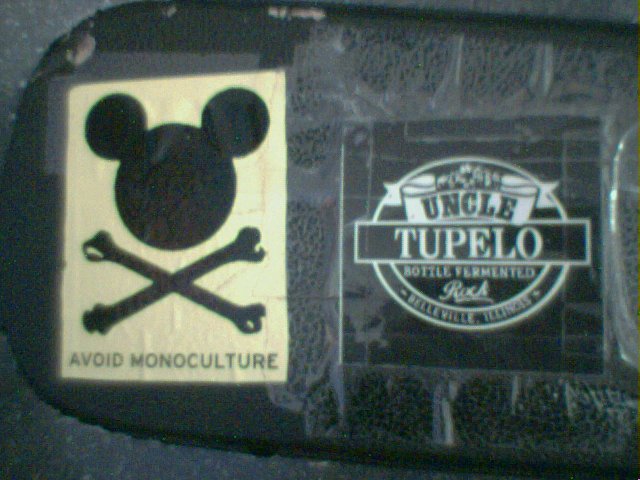
found the ut sticker on the floor at an EL station near the turn stile. Found the Avoid Monoculture as part of a larger punk band. So I clipped it off. Another conversation starter, stopper. Posted by Hello

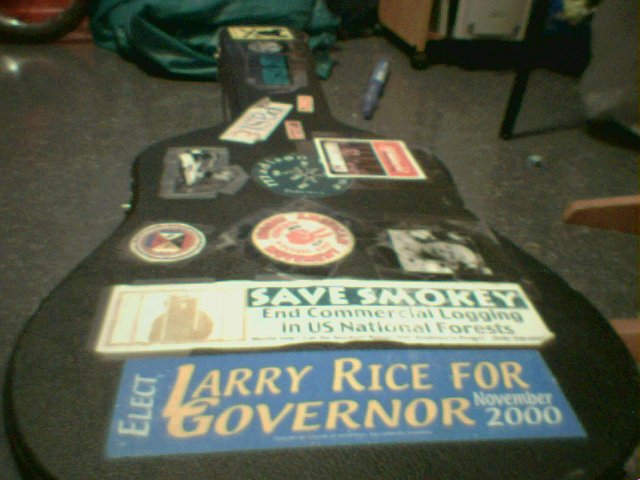
whole top from bottom. Posted by Hello

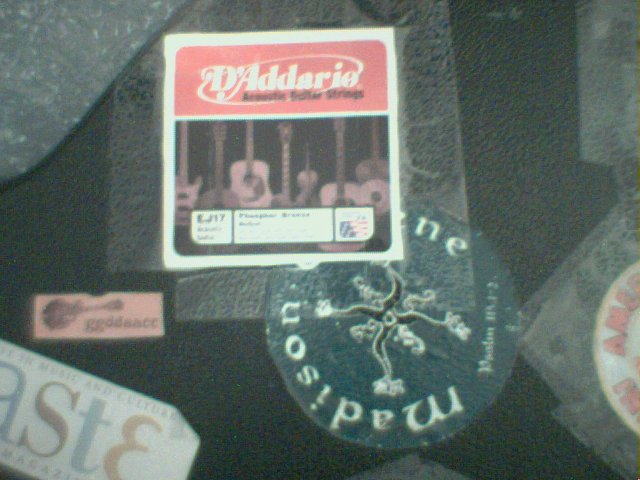
best strings for me. under them is a band that's ok and i couldn't rip the sticker off without messing up the case. it'll get covered eventually. Posted by Hello

another mag. Posted by Hello

found this lying in the dust on the floor of the roofing supply warehouse where i used to work. some wonder why i didn't leave it there. conversation starter, or stopper. Posted by Hello

favorite mag. Posted by Hello

the side. Posted by Hello

from 'kid brothers of st. frank' Posted by Hello

the man. Posted by Hello

the top of the case.  Posted by Hello

more of Martin Posted by Hello

"Sick of it all" was my favorite song by this guy. Posted by Hello

i've seen these folks in action in Bethlehem. They are severly underappreciated. Posted by Hello

my case. i've never heard this band, i just like the name. Posted by Hello

side with strap Posted by Hello

model Posted by Hello

this is my fourth kid, Martin. He's five years old now. Posted by Hello

finally Posted by Hello

still more Posted by Hello

and more (man this is easier than typing) Posted by Hello

more Posted by Hello

more Posted by Hello

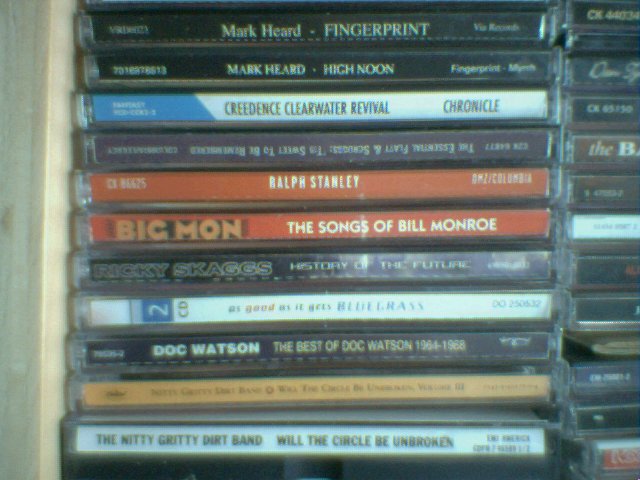
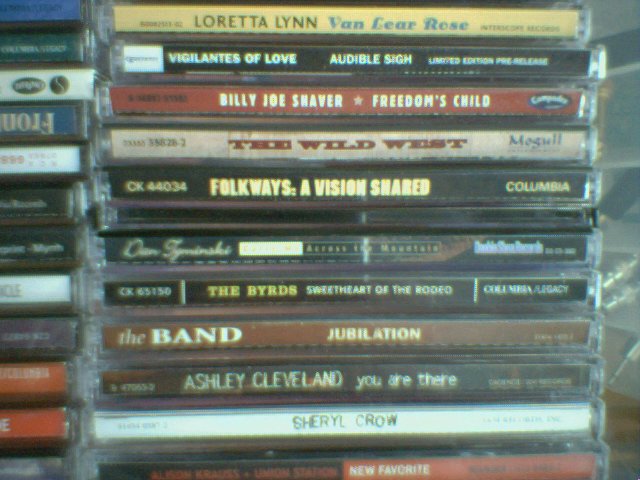
my collection at home Posted by Hello

2/07/2005


this is my cd collection at home Posted by Hello

2/05/2005

Well I finally purchased the new Buddy Miller Universal United House of Prayer and
Buddy & Julie Miller (after putting it off for waaaaaaaaaaaaaaaaaay too long). They've seen almost nonstop play at my work. I highly recommend them. As a concept album UUHP is the greatest thing I've experienced in a long time. Definitely gospel. Definitely insurgent. Makes me happy to call myself part of the flock. Which is a feeling I don't often have listening to mainstream Evangelicalalia.

1/31/2005

I'm pretty wiped out. And I've got LGFS (or little girl fatigue syndrome) from my middle child. Its very hard to reason with this five year old. I love her but after a long weekend with my wife away I feel like hiding from humans for a while. Its all I could do to keep my sanity. How could one be a parent to three young children and not need to get constant prayer? The vulnerability is there for all to see. And after a while the LGFS humbles me to the point that I don't care what people think of me. I'm going to ask for prayer.

1/16/2005

Well we just got in last night from visiting family in Missouri. Twisted my ankle loading the van and then noticed it swollen last night. It didn't really hurt that bad driving. Thank God for cruise control. All in all it was a good trip. Though travelling with three small children is no picnic. Glad to be home. No online activity for a week! Yes its possible.

1/04/2005

Well I did it. I went and posted my flaming review of the DVD George W. Bush : Faith in the White House. Posted on cornerstonemag.com

Here it is:

George W. Bush: Faith in the White House
A Critical Review
By Chris Rice

In 1992 Cornerstone Magazine published a major investigation into the book The Satan Seller by Mike Warnke and David Balsiger.1 It was found that Mike’s story was actually a lie. A very good one, but nonetheless not the truth. In October of 2004 Balsiger released a film: George W. Bush: Faith in the White House, that is—once again—a nonlinear narrative that uses all the right Evangelical phrases and appeals to create a response in its audience. 2

In this review of Balsiger’s film I hope to provide its evident and latent purpose, a thorough summary of the DVD Chapter Summaries, a survey of the propaganda techniques employed, the generalizations and assumptions, the misuse of quotes, and finally the question of his misuse of God’s Name and our shared salvation experience as Evangelicals. Its not that Faith in the White House has not been critically reviewed. Its been criticized in both the New York Times and Christianity Today. But my interest in the film lies in its ongoing impact. If David Balsiger gets away with propaganda and a nod to Christian fascism, and Christians don’t rise to call it that, we deserve to be misunderstood and ostracized by secularists and agnostics. We have brought it on ourselves.

DVD Chapter Summary

From the Introductory disclaimer claiming neither Bush nor his administration or election campaign had anything to do with the film to Chapter One titled “A Man of Faith,” the film claims an unbiased examination of whether Bush has brought Faith to the presidency. He is compared with Washington and Lincoln for his faith during an attack on US soil. His “Jesus is my favorite philosopher” quote during the Iowa debate in 2000 is followed by a negative critique from Jim Wallis, testimony from Doug Wead and another quote from Richard Gere. Its quickly apparent that the quotes and testimony don’t necessarily match or even dialogue with each other but rather serve to move forward the verbage of the film. This use of quotes and testimony is part of the formula. Critical quotes don’t represent the arguments of the figures themselves but only serve as a combined voice of “liberal bias.” Context, larger role, and intent are all unnecessary. What the film needs are strawpersons for an argument. Within the malaise they’re easy to find.

Chapter two entitled “Spiritual Strength” focuses on Bush’s sincerity with testimony from his close friend Rev. James Robison (“he would never lie”) and Robert Woodson, Sr. (“a comfort during my son’s death”). Chapter Three takes us on a journey through Bush’s life up to just prior to his conversion. “The Roots of Faith” contains a reenactment of his baptism and testimony to his devout religious raising, the story of the death of Bush’s sister, and his role as comforter to his mother. Stephen Mansfield uses this story to help us understand Bush’s current role as comforter of the nation. E. Donald Poage, a close friend, testifies to his Midland Texas values, but the chapter finishes by saying “you can take the boy out of Midland but you can’t take Midland out of the boy”, not all of Bush’s influences were good ones.

You might expect that chapter four would be heavy with the description of Bush’s excesses and carousing so that we could experience the glory of his conversion--but you’d be wrong. “Steps to Change” begins with the words “Most church-going Americans think Bush is right man at right time. . .” Reference to Bush’s hard living are only repeated as from his own mouth to emphasize his modesty and honesty. This chapter introduces my favorite person in the film, George’s Uncle Bucky. We the president’s own Evangelical family are so “in” with this President that his own Uncle Bucky will give us the inside track. Its from his testimony that we learn Bush’s daily regiment---or how he spends every disciplined waking moment. But in addition we learn of the sacred trust that is Bush’s Oval Office, and of how he’ll only wear a suit and tie there no matter the circumstances. Of course this devotion bothers critics, in an example we see a flaming criticism from Robert Sheer of the LA Times and then have that bit of indigestion washed down with another affectionate tome from David Aikman.

Weren’t we talking about Bush’s alcoholism? Well, not quite but let’s get back to somewhere near there. Chapter Five “Foundations of Faith” begins with Tom Frieling on how Bush inspires Christians in the Culture War before a critical quote from Al Franken on Bush’s secrecy and his suspicion of Bush’s religiosity. Stephen Mansfield helps us understand Bush as a man without direction. E. Donald Poage describes Bush’s meeting and prayer with Arthur Blessitt, all of which leads us to the most important event of the film (next to 9/11 of course) Bush’s time spent with Billy Graham. A reenactment of Bush sitting with Billy Graham in his living room help us capture that moment in time in the summer of 1985. The look-alike portraying Bush is a dead ringer in the face.

Chapter six, “Testing the Faith” demonstrates that, indeed, Bush’s faith held up against the temptations of the modern world, even the political world of Washington. Doug Wead testifies of the advances of a female intern and the shady offerings of a Washington bureaucrat. After Bush’s return from dad’s campaign things start going his way. He invests well in the Texas Rangers and runs for Governor, an office that Michael Minor assures us he could have never won apart from the rededication of his life to Christ. Unlike his opponent we learn he ran a positive campaign. This breeze of sunny history is punctuated by James Robison’s remark: “He became a man under control not out of control…guided by convictions of principles” edited directly to pan out wide shot of GWB in front of a giant water color Jesus mural. A well executed religious propaganda device to be sure.

Now that we’re assured of Bush’s sincerity and spiritual fitness for public service the film works to establish the need. Chapter seven, “America’s History of Faith” takes us back to the introductory question of faith-based administration. A critical quote from Susan Jacoby about there being no precedent for Bush’s “highly specific set of religious values” is answered by William Federer author of A Treasury of Presidential Quotations. We arrive now at the larger purpose behind the man of faith this movie profiles. “The Big question is have we reached that point in our history where faith and the Bible cease to be practically universal or is it possible that George W. Bush by his faith based example is leading the nation in a reawakening of those principles upon which it was founded?” The culmination of American history is realized with “Our” President because of his Evangelical faith.

We hear the testimony again of Robert Woodson, Sr. on how Governor Bush saved Teen Challenge from attack and set a precedent for faith-based funding. A quote from Ralph Nader on the lack of separation of church and state under Bush sets the stage for the vehemence of opposition from secularists. Since 1963 when the Supreme Court ruled against school prayer our children of faith have been under attack from cruel school administrations and humanists who will stop at nothing to brow-beat these poor kids for their faith. This is all illustrated with black and white photos of reenacted situations involving angry faced teachers and principles staring down at poor little confused children. Well at least Senator Zell Miller and Chief Justice Renquist come to Bush’s defense. One more critical quote, this time from Robin Lovin of Southern Methodist University questioning “Bush’s sense of calling related to his policies” and the film becomes a full on Love Fest for the president. James Robison, in a Classic Everyman Appeal remembers riding around the ranch with the president, Bush pointing out his secret places of prayer. Stephen Mansfield further clarifies Bush’s “promptings from God” and then Uncle Buckey chimes in about how Bush couldn’t do his job without Laura Bush. In a comment that would please even the most patriarchal of Southern Baptists we hear from Ted Haggard that Laura is a “colaborer with the President who would never dominate or upstage him.” Next come two quotes presented like caviats from the press to laud the Bush administration’s reliance on God from Newsweek’s Howard Fineman and BBC Correspondent Justin Webb. You’d think these quotes were simple first hand observations from the way they’re presented here. Not true, but more on that in the review. The chapter wraps up with an interview with Meagan Gillan of the Presidential Prayer Team. The Prayer Team has been in existence long before Bush came to power, but their existence seems especially appropriate for this film’s purpose.

Chapters eight “Witness for Faith” and nine “Faith in Action” are much the same as one and two, offering stories of Bush’s pastoral concern and saintly disposition. There’s the story of Sam Haynam, and thirteen year old with Cystic Fibrosis whom Bush gave special attention right before the war on Iraq. David Aikman shares a story of the special interaction between Bush and Putin that established a bond trust that later allowed US bombers to cross over Russia to bomb Afghanistan. He assures us this could never have happened with any other President.

Then its back to another critical quote from Barry Lynn of Americans United and a debate over what the Founders intended. This time though we learn over a photo montage of the presidents that every president turned to God for guidance, but that no other president in history has faced a “general uprising” against their faith except President George W. Bush. Now comes the 9/11 card. Photos of the grieving around ground zero. We need faith now more than ever.

Chapter nine, “Into the Fray” is the final chapter of “George W. Bush: Faith in the White House.” It deserves its own line by line critical analysis. In fact it makes the film top heavy with its weight of emotion and grandiosity. The Iraq war has barely been treated up to this point. And now in the last twenty-seven minutes of the film three years of history will be recounted and interpreted in light of what we already know. It begins with Ted Haggard and James Robison recounting Bush’s premonition that “the nation is going to need me at this time.” Which leads us to. . .

“On Sept. 11, 2001 that premonition came true. The world changed perhaps forever.” The next several minutes are of video footage of the devastation of the World Trade Center. Janet Parshall’s voice recounts an idea from “misguided critics” suggesting that Bush’s faith is no different than the terrorists religious zeal. But then the film takes the critic’s line of reasoning to the next level by suggesting that maybe Bush hugging a fourteen year old girl at ground zero was the same as a terrorist strapping his son with explosives. A photo of Bush hugging this fourteen year old girl whose parents were killed in the bombing is slowly brought to the front of the screen. Amazing how a subtle idea can serve the purpose of demonization without the need for an actual critical quote! Next we see Bush with his arm around a fireman and the infamous interaction “I hear you and the world hears you!” followed by a Tour De Force through history from 9/11 to present. All of Bush’s intentions are made clear. He rebuilds Afghanistan and Iraq. Iraq is actually a much better place despite what we hear.

Most shocking are Dr. Ted Haggard’s remarks on how Bush will be perceived in the Islamic world. "President Bush will be known as the man who stood up to Islamic Fundamentalism being used to tyrannize their own people. So in another hundred years, in the Islamic world he'll be viewed as a great liberator and the one who began the process to set them free from those who use Islam to enslave Islamic people politically." In the position of president of the National Association of Evangelicals Haggard is not speaking only for himself, especially when he speaks on the writing of future history. He has a responsibility to the many members in the NAE. These remarks are terribly irresponsible and presumptive. One would think his training brought him above such a grandiose declaration for people of another culture, another religion, and certainly of another political persuasion than his own.

Instead of there being any prophetic witness to the White House in this film, Bush himself is placed in the role of prophet to the world, the example being in his speech to the UN on slave traffic. But there’s a price to be paid for this faith, and it comes in the form of persecution from Michael Moore. Michael the propagandist, we are told, prepared an all out assassination on the president’s character. But in this case we finally have critical quotes on the screen in defense of the president. Fahrenheit 9/11 is only propaganda and not to be taken seriously.

A few more stories from David Aikman of Bush’s saintly affection toward soldiers wounded in battle and the film is finally at its closing comments.
Janet Parshall looks us in the eye and speaks in the first person:

"President George W. Bush has set the example for maintaining faith in the face of unrelenting criticism. In my book Tough Faith I presented a road map for the dangerous deception that lies ahead. As the president has so ably demonstrated it is vitally important for Christians to be fully engaged in the religious and cultural conflicts of the twenty-first century. Will the faith of George Bush be sufficient to keep us in God's hands today? Perhaps if we all join our faith to his."

If in my darkest dreams I never thought Evangelicals capable of Fascism, with these words she has finally made me a believer. I confess that my walkthrough of this film is not thorough enough. I heartily suggest, even implore David Balsiger and Grizzly Adams Productions to do as Michael Moore has done for his film and offer the equivalent of The Fahrenheit 9/11 Reader. Moore has stuck his neck out by offering the complete screenplay and source material for every allegation made in his film. I wonder if Balsiger’s film could hold up to such scrutiny. Actually I don’t. I know it wouldn’t!

The purpose of Faith in the White House is not a secret. The cover packaging says it all: “This film will inspire you.” It also claims to be an alternative to Michael Moore’s Fahrenheit 9/11 and non-political in nature. In this way its stated purpose is to profile the faith of George W. Bush against the critics of faith and Traditional Values. These are the claims the films makes of itself. But the latent purpose of the film is very political. Its purpose is to profile the man George W. Bush and his office as providentially given in a way that Evangelicals in particular will identify with and act upon. Obviously the action intended was votes for the president.

Propaganda Techniques Used

Faith in the White House to my knowledge is perhaps one of the most blatant forms of propaganda used by an Evangelical organization for political leverage and electoral victory in recent history. Propaganda is a word with obviously very negative connotations. So I want to clarify why I believe this film falls into this category. Propaganda by definition is an attempt to persuade a group of people to agree with the sponsor using arguments that mislead, dodge, and or are manipulative. This film was given syndication on major Christian television stations across the country, used at the Republican National Convention, shown in churches, and sold in bookstores. But in what is a clear deception, it is marketed as a non-political, inspirational product. Is that just a silly misnomer? Or is the director claiming it is non-political for specific reasons? One reason would be that Christian TV stations and churches could use this film without compromising their ethics by giving time to only one political candidate.

Propagandacritic.com lists ten common techniques used by propagandists to persuade an audience. I see Balsiger blatantly using seven of these in this film and they include Glittering Generalities, Euphemisms, Plain Folks, Bandwagon, Unwarranted Extrapolation, Bad Logic, Transfer, and Testimonial.3 By avoiding the uglier face of propaganda, the name calling and fear appeal, the film has a very nice “Christiany” appeal to it. It draws on assumptions that already exist within society, namely that George W. Bush is a man of faith, and it solidifies that assumption into an argument using mainly Testimonial from close friends, former aides, family members (like Uncle Buckey), and noted ministers such as James Robinson and Ted Haggard. Billy Graham and Arthur Blessitt, the two key figures in the anatomy of GWB’s conversion, are not interviewed personally, but serve as testimony by virtue of their status as noted Evangelists. This film is all about Transfer, "a device by which the propagandist carries over the authority, sanction, and prestige of something we respect and revere to something he would have us accept.”4

In addition to these devices it appeals to something unique to its audience--a personal salvation experience and a belief in the Lordship of Jesus Christ over every area of an individual’s life. Reference to the Presidential Prayer Team in this context suggests prayers for the President translate into votes for the president. This use of our faith as a device for coercion marks a new low in religious dialogue, and compromises the very nature of our faith itself. Stephen L. Carter, in his book God’s Name in Vain: The Wrongs and Rights of Religion in Politics5 writes:

“And there lies the difficulty when God-talk mixes with the partisan side of politics: More than likely for too many people with causes to push and desires to fulfill, the name of God will collapse into a mere rhetorical device. Instead of maintaining the sacred character guaranteed by the Third Commandment, God’s name becomes a tool, a trope, a ticket to get us where we want to go.”

Carter writes on religious dialogue in politics and the importance of its role as prophetic witness. He says that religious dialogue is at its worst when employed as an electoral device. He gives examples from the writings of Dietrich Bonhoeffer and CS Lewis, the resistance of Fannie Lou Hamer, and the compromise of the Christian Coalition in its Contract with the American Family. In addition to this book, much can be gained from Jaques Ellul’s writings on the Church’s activity in the political realm in his works The Presence of the Kingdom and False Presence of the Kingdom, and on a different but related topic, Propaganda: The Formation of Men's Attitudes.
.
Generalizations and Assumptions

The film employs many sweeping generalizations and assumptions about President Bush, Evangelical Christians, the founding fathers, and the nature of the culture war itself. It seems to insist that Bush is “our” president---one of us--- against the onslaught of the culture war. President Bush is portrayed as much further to the right than his own record has proven. Evangelicals are portrayed as a monolithic voting block who without question embrace the concerns of the filmmakers. The founding fathers are spoken of and honored in a manner befitting the interests of the Constitution Party, not Republicans, and every quote critical of the president falls into a stereotyped opposition to the president as part of the culture war. These generalizations easily resonate with the gut feelings of many Americans, regardless of real statistics, and serve the purposes of the film. But this level of discourse is not beneficial toward either side and serves only to polarize Americans. For a discussion of Bush’s faith that achieves greater objectivity and seeks a truer portrait of Bush and Evangelicals see Frontline’s special and the transcripts of interviews on its website.6

Misuse of Quotes
And what of the misuse of quotes in the film? In the case of Justin Webb, BBC Correspondent, his quote was used in a way that is of the exact opposite of it’s original intent. On September 4 Justin wrote:
“A year or so ago on this programme I said: "Nobody spends more time on his knees than George W Bush". It was intended as a faintly ironic comment on the president's religiosity. Imagine my surprise when I came across a copy of the DVD, George Bush: Faith in the White House. On the back among the glowing endorsements: "Nobody spends more time on his knees than George W Bush says BBC Washington correspondent, Justin Webb." I have endorsed the president without even intending to.”7
The actual article Webb wrote from which the film quotes is still online and starts out with the sentence, “My wife and I do not believe in God.”8 In reading the article itself it becomes clear that Webb is satirizing and mocking the Bush administration for its’ religiosity, not offering a glowing accolade from firsthand observation. When a film turns around mockery and manages to make it sound like genuine praise, shouldn’t someone cry foul?
On March 10, 2003 the article “Bush and God A higher calling: It is his defining journey--from reveler to revelation. A biography of his faith, and how he wields it as he leads a nation on the brink of war”9 by Howard Fineman and others appeared in Newsweek magazine. The quote used in the film “this president—this presidency--is the most resolutely "faith-based" in modern times, an enterprise founded, supported and guided by trust in the temporal and spiritual power of God” is not meant as a glowing endorsement, but only a description for effect. In May of 2004 Fineman wrote a piece on Bush’s involvement with Tim Lahaye, not to endorse Lahaye or Bush but no doubt to pair the two to arouse suspicion about Bush’s intentions in foreign policy.10 The film’s misuse of quotes from Fineman and Webb further illustrate the lengths to which director David Balsiger is willing to go to elect a president.

Misuse of God’s Name

Clearly a film that uses Christian ministers, the Christian experience, and the concept of Faith as its keystone, has taken on itself a great responsibility. A Christian audience expects that the Name of their God will not be taken in vain. But this is exactly what this film does. It calls into question God’s Calling of men throughout history by anointing Bush as God’s man for these times. If Bush slips up and proves himself less Christian, the blame falls on God. Finally it makes a mockery of God by asking whether our president’s faith would be enough to keep us in God’s hands, and suggesting that by joining our faith to the president’s this might be so. This makes God into a somewhat powerful deity who can only preserve a nation’s safety and posterity through the righteousness of its leadership. We the nation’s people, then need a vicarious faith together with that leader’s to enable God to act. For the filmmakers the problems America is facing, namely the culture wars and terrorism, are too great for either God or the American people to overcome, so we need the man of God’s choosing--George W. Bush.

Misuse of the Conversion Experience

As Evangelicals we believe in a personal experience with God through faith that enables our day to day existence. That is the initial conversion experience. It’s a rather existential moment in which God touches us deeply with the awareness of his love and forgiveness and that changes us. Throughout our lives we form and sustain relationships regularly but none of these is more valuable than our relationship with Jesus Christ. It’s a very personal thing, not something to be packaged and used to win votes. And neither should it be used to prove the validity of someone’s character. A Christian employer would be quite foolhardy to consistently hire on the basis of his employee’s conversion story. Wouldn’t their job performance matter? And would it make any difference for the employer to call in a tardy employee and say “I thought you said Jesus really changed your life? I trusted you!” What if we called in a bunch of the employee’s friends and asked them all “Is this person really saved?” “Tell me about their conversion experience.” Would these things really get to the bottom of either the person’s faith or performance? No. So to use one’s conversion experience to justify performance is to misuse the experience altogether. In the Bible we have a record of God calling into question man’s actions on a regular basis, not to overlook or justify them, but to set them right. If God has done this in covenant relationship with man for thousands of years, how does the film maintain that George W. Bush somehow achieves only justification and exemption?

Conclusion

The place of faith in politics is an important discussion, especially now. Which is why it matters when faith is misused. We need a discussion of faith in public life and how it speaks to issues such as war and poverty, terrorism and foreign policy and the good and bad in American history. Maybe something on how faith informs US/Saudi relations, our involvement in the Middle East, or Medicare and tax cuts. Instead what we got in this film was a rosy picture of Bush’s faith, acts of love, and conversion and how he fulfilled God’s destiny---while a world of hostile hateful evildoers continue to rage against him. Chief speechwriter to the president, Michael Gerson, recently held a press conference to clarify the President’s intentions in speaking of his faith. He said, "The important theological principle here, I believe, is to avoid identifying the purposes of an individual or a nation with the purposes of God." "That seems a presumption to me, and we've done our best to avoid the temptation."11 Let’s hope that as Bush begins a second term this is indeed true. In his inaugural address there will no doubt be more talk of God and faith. While we don’t want to confuse the man George W. Bush with the film’s depiction, what we really need to see in the next four years is a sense of honesty, humility, and contrition. These befit any president, but in order to unite the nation after a very divided election they would definitely be a ray of hope. After a year of both demonization and deification in the press, it may be impossible for Bush to live up to expectations in a second term. It should be no small comfort to us that our president is only human and in need of our prayers—whether or not we voted for him.


1 The Satan Seller article link and book info
http://cornerstonemag.com/pages/show_page.asp?389
http://cornerstonemag.com/pages/show_page.asp?390
http://cornerstonepress.com/titles/warnke/index.html
2 More reading on David Balsiger
This article lists some of Balsiger’s projects and includes Balsiger’s comments on the objectivity of his film contra Fahrenheit 9/11 http://headlines.agapepress.org/archive/9/afa/272004f.asp
“Update on the Ark Hoax” by Jim Lippard
http://www.skeptic.com/02.4.lippard-ark-hoax.html
Press Release on the Ark Hoax
http://www.skeptic.com/balsiger-release.html
3 http://www.propagandacritic.com
see also http://en.wikipedia.org/wiki/Propaganda
4 http://www.propagandacritic.com/articles/ct.fc.transfer.html
5Carter, Stephen, God’s Name in Vain: The Wrongs and Rights of Religion in Politics, Basic Books, 2000.pgs. 16-17.
6Frontline links
Extended interviews:
http://www.pbs.org/wgbh/pages/frontline/shows/jesus/interviews/
Front page: The Jesus factor
http://www.pbs.org/wgbh/pages/frontline/shows/jesus/
Evangelicals
http://www.pbs.org/wgbh/pages/frontline/shows/jesus/evangelicals/bushand.html
Read Steve Waldman’s (of Beliefnet) understanding of George Bush and see how it differs from Balsiger’s depiction:
http://www.pbs.org/wgbh/pages/frontline/shows/jesus/interviews/waldman.html
7Justin Webb comment on film
'I accidentally endorsed the President'
By Justin Webb
BBC Washington correspondent
Saturday, 4 September, 2004
http://news.bbc.co.uk/1/hi/programmes/from_our_own_correspondent/3624610.stm
8 Justin Webb from the article itself
Friday, 14 March, 2003,
“America's deep Christian faith”
By Justin Webb
BBC correspondent in Washington
http://news.bbc.co.uk/2/hi/programmes/from_our_own_correspondent/2850485.stm
9 Newsweek, March 10, 2003,
“Bush and God, A higher calling: It is his defining journey--from reveler to revelation. A biography of his faith, and
how he wields it as he leads a nation on the brink of war.”
Author: Howard Fineman
With Tamara Lipper, Martha Brant, Suzanne Smalley and Richard Wolffe
Found at http://www.cla.sc.edu/POLI/faculty/rosati/fineman.god.newsweek.303.htm
10 Newsweek May 24, 2004
“Religion: Apocalyptic Politics
Ties That Bind: Bush and LaHaye have a history, and share a sense of mission”
By Howard Fineman
Found at: http://msnbc.msn.com/id/4988491/site/newsweek/print/1/displaymode/1098/
11Bush's References to God Defended by
Speechwriter
President Does Not Claim Divinity Is on His Side, Gerson
Contends
By Alan Cooperman
Washington Post Staff Writer
Sunday, December 12, 2004; Page A06
http://www.washingtonpost.com/wp-dyn/articles/A57915-2004Dec11.html
See also: http://www.dallasnews.com/cgi-bin/bi/gold_print.cgi

Other Reviews
New York Times, 10/03/04
"Now on DVD: The Passion of the Bush" by Frank Rich
http://www.nytimes.com/2004/10/03/arts/03rich.html?8hpib
Christianity Today Review
http://www.christianitytoday.com/movies/reviews/georgewbush.html

On Point radio interview with David Balsiger and others discussing the film, religion, and politics. Insightful discussion.
http://www.onpointradio.org/shows/2004/10/20041005_a_main.asp

Recommended Reading
Stephen L. Carter, God's Name in Vain: The Wrongs and Rights of Religion in Politics, Basic, 2000.
Jacques Ellul, The Presence of the Kingdom, 2nd Ed., Helmers & Howard, 1989.
False Presence of the Kingdom, The Seabury Press, 1972.
Propaganda: The Formation of Men's Attitudes. New York: Vintage Books, 1965.